

Legal explainer
Is IPTV Legal? How the Law Treats Streaming Services
By CatchON TV Support TeamPublished
On this page
IPTV itself is legal. It is simply a way of delivering television over internet protocol, used every day by licensed broadcasters and pay-TV companies. What can be illegal is distributing channels, films or sport without permission from the rights holders. Whether a particular IPTV service is lawful depends on the licences behind its content and the law where you live.
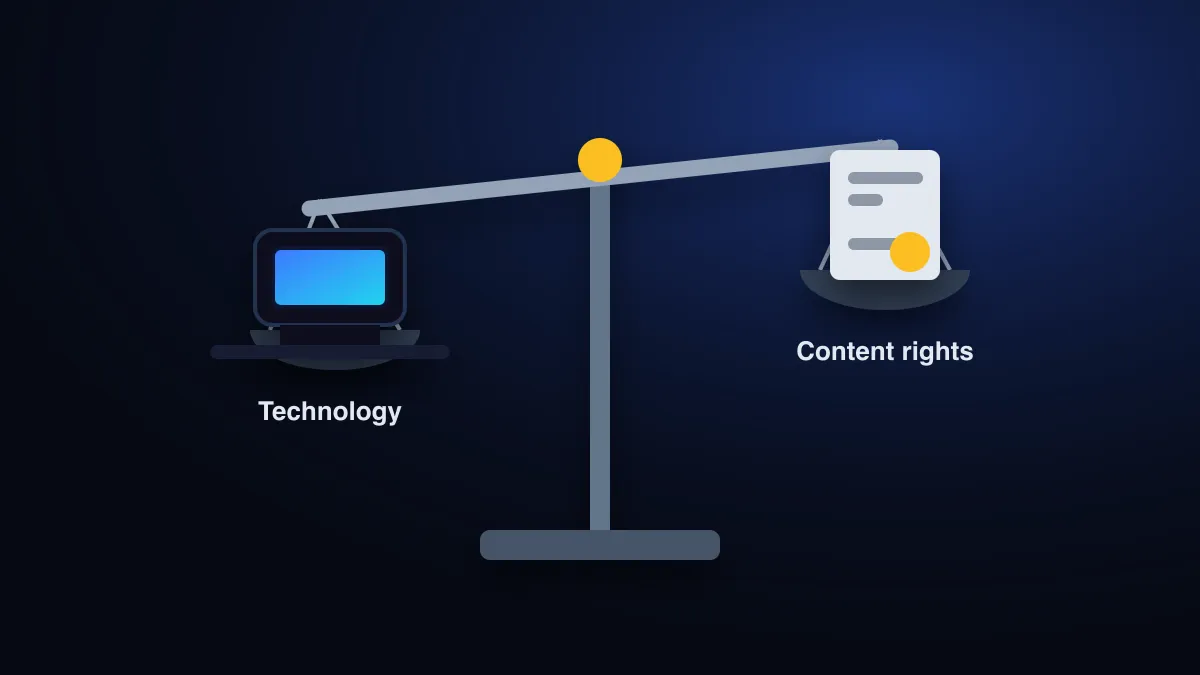
Technology vs content rights
The International Telecommunication Union describes IPTV as multimedia services “delivered over IP-based networks” (ITU-T). Nothing in that definition is about who owns the programmes. The same technology carries a telecom operator’s licensed TV package and an unlicensed reseller’s channel list.
So the useful question is never “is IPTV legal?” but “does this service have the right to show what it is showing?”
| Question | What decides the answer |
|---|---|
| Is the technology legal? | Yes, in general. IPTV, M3U playlists and player apps are lawful tools |
| Is this service legal? | Whether it holds or has licensed distribution rights for its channels and films |
| Is it legal for me to watch? | Your country’s copyright law, and in some countries whether you knew the source was unlicensed |
Is IPTV legal in the United States?
US copyright law gives rights holders control over public performance of their work, which includes streaming it to subscribers. In December 2020 Congress passed the Protecting Lawful Streaming Act, which made it a felony to run, for commercial advantage, a digital transmission service designed or marketed for streaming copyrighted works without authorisation (overview). Penalties reach up to ten years in prison for the most serious offences.
The act targets operators. Its legislative history makes clear it is not meant to criminalise mainstream services or their customers (Copyright Alliance). Civil liability under general copyright law is a separate matter.
Prosecutions happen. In July 2025 the US Department of Justice announced sentences of up to 84 months in prison for people who ran Jetflicks, a paid subscription service it described as making available “more television episodes than any licensed streaming service on the market” without authorisation (DOJ).
Is IPTV legal in the EU?
In 2017 the Court of Justice of the European Union ruled in the Filmspeler case (C-527/15). It found that selling a multimedia player pre-loaded with add-ons pointing to unlicensed streams can itself infringe copyright. It also held that the temporary copies made while streaming from an illegal source are not automatically covered by the exception for temporary copies (CJEU press release).
That second point matters for viewers. In the EU, knowingly watching unlicensed streams is not automatically protected just because nothing is saved to your device. How it is enforced varies between member states.
Outside the US and EU, rules vary widely. In the UK, a 2024 case ended in a prison sentence for watching as well as selling unlicensed streams. See IPTV in the UK. In Canada, courts have ordered internet providers to block an unauthorized service: IPTV in Canada. Elsewhere, check your own country’s copyright authority or consumer-protection agency.
What it means for viewers
| Risk | What happens |
|---|---|
| Service disappears | Prepaid months are lost when a site or server is shut down |
| Payment exposure | Card details given to an anonymous seller; some only accept irreversible payment methods |
| Malicious apps | Players from unofficial sources can carry malware |
| No recourse | Little chance of a refund or complaint process that works |
How to check an IPTV provider
No checklist proves a service is licensed, but these questions separate sellers who can show their homework from those who can’t:
- Does the seller name a company, an address and a way to contact a person?
- Can it explain where its channels come from, or point to licensing information?
- Are prices in line with what licensed live-TV services charge for similar channels?
- Are its apps in official app stores, or only available as downloads from the seller?
- Does it publish refund terms and accept payment methods with buyer protection?
- Does it avoid “every channel in the world for a few dollars” style marketing?
If a seller can’t answer, you can’t confirm the service is lawful. Applying the same questions to CatchON TV, Is CatchON TV legal and legit? sets out what we can and can’t confirm.
Common myths
“If it’s on an app store, it must be legal”
Player apps are legal tools and are approved as players. The store doesn’t check what you load into them. Legality depends on the playlist, not the app.
“Streaming isn’t downloading, so viewers are always safe”
In the EU, the Filmspeler ruling rejected that argument for streams from sources the viewer knows to be illegal.
“All IPTV is piracy”
Also wrong. Many licensed services deliver TV over IP. How IPTV works explains the technology, and our comparison of licensed IPTV options shows what the licensed market looks like. Before signing up anywhere, read how to choose an IPTV subscription.
Sources
- IPTV-JCA Terms of Reference (definition of IPTV) — International Telecommunication Union (ITU-T) (accessed )
- Protecting Lawful Streaming Act — Wikipedia (accessed )
- Protecting Lawful Streaming Act Signed Into Law: What You Need to Know — Copyright Alliance (accessed )
- Five Defendants Sentenced in Connection with Operating One of the Largest Illegal Television Show Streaming Services in the United States (July 22, 2025) — U.S. Department of Justice (accessed )
- Press release: judgment in Case C-527/15 Stichting Brein v Jack Frederik Wullems (Filmspeler) — Court of Justice of the European Union (accessed )
Ready to try it on your own TV? The setup guide walks through each device.
Read the setup guide